
How to Download Audio Track For Movies in Multiple Languages (2026)

Summary: Are you eager to download the audio track of a movie but find yourself at a loss for an efficient method? Are you still resorting to the antiquated technique of recording the audio and then converting it to MP3 format? This article will rescue you from such predicaments. Effortlessly download movie audio tracks while enjoying the option to choose from multiple languages.
Introduction
A movie audio download starts with a common frustration: you have the film, but not the dialogue language you need. Confirm that the track exists, then use the source directory below for a matching authorized file or continue to the download and extraction workflows when the source title offers that audio.
Selecting an audio language uses a track already offered for the title; it does not create a new translation. Dialogue tracks are different from score music and audio description. A subtitle supplies text rather than a spoken dialogue track. Keeping those outputs separate makes it easier to find the right method for movie audio tracks in different languages.
I organize the choices around two questions: does the source offer the target language, and do you need a video file or separate audio? If your goal is simply to download audio from a website as an MP3, a general web-audio workflow may be enough.
Related Topics: how to download Netflix subtitles
Where to Download Ready-Made Multi-Language Audio Tracks
For content you’re authorized to access, where permitted by platform terms and applicable law, first check the distributor or rights holder’s title-specific download options and any alternate audio tracks included with an authorized copy. These are places to check, not a guarantee that a separate dub file is available.
Confirm what you actually need before downloading anything. A dialogue dub replaces spoken dialogue, a score is the movie’s music, audio description adds narration for visual content, and subtitles provide text rather than spoken audio. If you need text instead of a spoken dub, see this guide to How to Download Subtitles for Movies. AudioVault describes audio-described film and TV sound rather than a general catalog of dialogue dubs.
HollywoodHindiTracks has historical Hindi-dub listings, with its latest visible listing dated February 6, 2019. Treat it as an older directory reference rather than a current recommendation, then return to the distributor, rights holder, or authorized copy to determine what tracks are available for the specific title.
Before pairing a separate track with a movie, confirm the requested language, distinguish dialogue from audio description or commentary, check that your use is permitted, and match the film cut and runtime. If you already have the film and need a separate track, I would start with an authorized title-specific source; if the streaming title offers the language, continue with the workflow below.
Essential Pre-Download Guide: Audio Formats and Personal Backup Rules
Choose the output before choosing the method: a separate audio file, an MP4 or MKV video containing the selected track, or a temporary external-audio pairing for playback.
Why Streaming Access Differs from a Downloadable Audio File
A streaming subscription authorizes viewing under the service’s terms, but it does not by itself grant permission to copy or redistribute movie audio. Save a local copy for personal offline viewing only when you have authorized access and permission for the content. Do not redistribute it, and follow applicable law and platform terms; the specific permissions depend on the use case.
Select the Right Format: AAC, EAC3, or Atmos?

The bottom line: For everyday listening, AAC is perfect. For a true cinema experience, go for EAC3 or Atmos.
- AAC (Advanced Audio Coding): AAC is a lossy audio codec that balances sound quality and file size. It has broad playback support, although compatibility still depends on the player and device.
- EAC3 (Dolby Digital Plus): EAC3 is a lossy codec that can carry multichannel audio, including 5.1 when the source title offers it. Preserving the source-encoded track avoids an additional audio transcode, but it does not make the codec lossless.
- Atmos (Dolby Atmos): Dolby Atmos adds spatial audio information to a supported audio stream. It is available only when the title, service, plan, playback device, and audio setup support it.
MP4 and MKV are containers, while AAC and EAC3 are audio codecs. Dolby Atmos describes an immersive presentation that may be carried by a supported source track. Available codecs, channels, and Atmos playback depend on the title, service, plan, container, and playback equipment. Preserving the available encoded source track avoids additional transcoding, but EAC3 itself uses lossy compression.
A Quick Word on Copyright and Fair Use
Keep the workflow within five practical boundaries: use an authorized account, work only with content you are authorized to access, do not redistribute the result, follow applicable law and platform terms, and consider permissions for the specific use case. StreamFab All-In-One is positioned as a personal-backup tool for authorized offline viewing.
1. StreamFab Downloader: Save Original Multi-Language Audio Tracks

- Support for 1,000+ Services: Save authorized titles from services such as Amazon Prime Video, Netflix, Disney+, and YouTube.
- Original Audio Options: Select offered AAC, EAC3, AC3, or Dolby Atmos audio when available for the title.
- MP4/MKV Output: Save the video with the selected available audio track in MP4 or MKV.
- Batch Downloads: Queue multiple authorized titles or episodes for repeat viewing.
- Metadata Preservation: Keep subtitles and media information organized automatically.
For Windows and Mac users, StreamFab All-In-One is a desktop route for retaining an audio language that the source title already offers. It works separately from each service’s official download feature and saves the selected audio with video in MP4 or MKV. A lightweight extraction workflow may be simpler when you need only audio from a supported authorized URL, while StreamFab is better suited to preserving offered source tracks, subtitles, and metadata in an organized video file. If an offered language does not appear or processing fails, use the app’s update or support path with the app version, service, title, and selected language.
5 Simple Steps to Save Movie Audio Tracks
Step 1: Use the official Windows or Mac download option below, install StreamFab All-In-One, and open the application.

Free Download macOS 12.0 or newer
Step 2: Open the service, sign in with your authorized account, and find the movie whose available audio track you want to retain. Start playback so StreamFab can inspect the title.

Step 3: Review the audio languages and output choices offered for that title, then select the language and MP4 or MKV format that fit your playback setup.

Step 4: Start the download to save the permitted MP4 or MKV video with the selected audio track.

Step 5: Open the completed file and inspect the active language, codec, and channel information in a compatible player. If you need a separate audio file, continue to the authorized extraction workflow below.
Batch Downloads for Repeat Viewing
Batch downloads are useful when you want to queue multiple authorized titles or episodes for repeat viewing.
Scheduled episode follow-up can organize later downloads, but choose an available audio language for each title instead of assuming one job will package every language.
2. yt-dlp: Extract Available Audio from Supported Sites
For command-line users who need a separate audio file from an authorized, supported URL, yt-dlp can inspect the formats and languages the site actually exposes. It does not create a missing dub, and audio extraction requires FFmpeg and ffprobe.
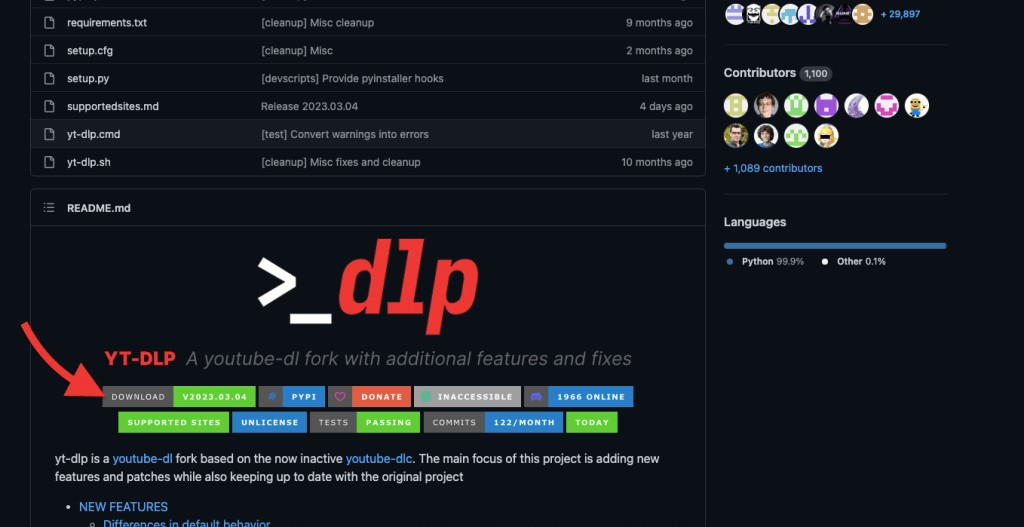
- Supported-Site Workflow: Inspect and select audio formats from URLs that yt-dlp supports.
- Language Visibility: Use the format listing to choose a language actually exposed by the site.
- Extraction Prerequisites: Separate audio extraction requires FFmpeg and ffprobe, and MP3 output re-encodes the source.
Use yt-dlp for Quick Audio Extraction
For command-line users obtaining authorized audio from a supported URL, first install yt-dlp with FFmpeg and ffprobe, then inspect the available formats with yt-dlp -F [VIDEO_URL]. Select an audio format ID and language actually listed, then run yt-dlp -f [AUDIO_FORMAT_ID] --extract-audio [VIDEO_URL]. Audio extraction requires FFmpeg and ffprobe; requesting MP3 with --audio-format mp3 re-encodes the audio and does not select a dialogue language. Retaining multiple audio streams requires explicit format selection, --audio-multistreams, and a compatible container. If the wanted language is not listed, move to the recording workflow below rather than assuming yt-dlp can create it.
3. RecordFab: Record Movie Playback on Windows
I treat RecordFab as a fallback for a short authorized recording when a direct-download workflow does not fit. The Difference of Downloading and Recording matters here because a downloaded file and a playback capture are different outputs. RecordFab is a Windows video recorder with MP4 and MKV output and 720p or up to 1080p resolution. A video recording and a separately extracted audio stream are different outputs; use FFmpeg afterward if you need an authorized standalone audio file.
- Windows Recording: Record authorized movie playback when a direct-download workflow does not fit.
- Video Quality: Record in 720p or up to 1080p.
- Video Output: Save recordings as MP4 or MKV files.
- Separate Audio Extraction: Use FFmpeg afterward if you need an authorized standalone audio file.
- Different Output: A recording is a video file, not an original multichannel audio download.
Record a Movie with RecordFab
Add or Sync a Downloaded Audio Track to Your Movie
Once you have the audio-track file in hand, you’ve got two routes: play it alongside the video temporarily, or mux it permanently into the movie file. For a one-off listen, I’d use a temporary VLC pairing; for repeat playback, mux the track into an MKV file with MKVToolNix.
Before adjusting sync, confirm that the audio matches the same film edition and runtime. A constant offset can be corrected with a delay adjustment, while steadily increasing drift points to a rate mismatch that may require linear timestamp scaling. The documented mkvmerge --sync option supports both approaches, but audio from a different cut needs a matching track rather than a universal offset fix.
Play a Track in VLC Without Re-Muxing
The fastest way to test a downloaded audio track is to load it as an external track in VLC—nothing is written to disk, nothing about the movie file changes.
- Open the movie in VLC.
- Do not use Audio > Audio Track > Open File as a single menu path. In VLC, Media opens files, while Audio > Audio Track selects a loaded audio stream.
- Once the external audio is loaded, use Audio > Audio Track to select that stream.
- VLC plays the movie against the external track for this session; close VLC and the pairing is gone.
This temporary pairing lets you check the language, playback, and basic synchronization before committing to a mux.
Merge a Track into Your Movie File with MKVToolNix
When you want the new track built into an MKV file for repeat playback, use MKVToolNix. It multiplexes the selected streams without re-encoding them, so it does not introduce additional transcoding loss.
- Open MKVToolNix and drag the video file into the Multiplexer window.
- Drag the new audio track into the same window; it’s added as an extra track.
- Set the Language for the new track, and toggle Default track if you want it to play automatically.
- Choose the output filename and click Start multiplexing.
Check the finished MKV at the start, middle, and end. Confirm that all intended tracks remain, the language tags are correct, and the preferred track has the appropriate default setting. Playback also requires a player that supports the MKV container and the included audio codec.
Quick Decision: Match the Method to Your Audio Needs
My rule is to match the method to the output: use a selected-source download to retain offered movie audio in a video file, extraction for authorized audio from a supported public URL, and recording for an authorized playback capture. StreamFab All-In-One and RecordFab produce video files in these workflows; a standalone audio file requires an extraction step.
| Method | Workflow | Output |
|---|---|---|
| StreamFab | Save offered movie audio with video | MP4 or MKV video |
| yt-dlp | Extract selected supported-site audio | Separate audio via FFmpeg |
| RecordFab | Record authorized movie playback | MP4 or MKV video |
Frequently Asked Questions (FAQ)
Conclusion
Choose the route that matches both your source and the file you need. If a streaming title offers the desired language and you want a video with that track, use the download workflow. Use yt-dlp and FFmpeg for supported URLs when you need a separate audio file, RecordFab for an authorized playback recording, and VLC or MKVToolNix when you already have a matching external track to play or add.

Browser shows "no valid sources are available for this video" and the video won't play? In July 2026, I reproduced this error on six different streaming sites and identified the exact cause in each case. Here's the triage path that resolves 95% of cases.
By Marcia Hatcher - Oct 13, 2026
FuboTV lacks an official download feature, but tools like StreamFab (for on-demand shows) and RecordFab (for live events) let you save videos in high quality. This guide compares both methods, explains setup steps, and covers Fubo’s pricing and legal safety—ideal for sports fans who want offline access to World Cup games and highlights.
By Jacob Harrison - Oct 12, 2026
Tested in June 2026 — here are the 7 best Firefox video downloader extensions ranked by Manifest V3 compatibility, max quality, and real-world performance, plus a desktop alternative for DRM-protected streams that browser add-ons simply cannot handle.
By Jacob Harrison - Oct 12, 2026
Are you looking for the best media converter Mac software to address iTunes playback restrictions? Having a reliable video tool at hand will enable you to enjoy your iTunes movies and music for offline play flexibly. You have come to the right page. This post lists the top 5 best converters for Mac used to back up iTunes videos, audiobooks, and Apple Music on Mac easily.
By Nicole Lopez - Sep 29, 2026