
VidiCable Not Working? 5 Checks and Error-Code Fixes (2026).

Summary: Fix VidiCable errors with five fast checks, a current code-to-fix matrix, and targeted steps for black screens, storage failures, and files that will not play. The guide also clarifies codec, format, device, licensing, support, and desktop fallback boundaries.
When VidiCable is not working, the useful first question is whether the failure happens before download, during processing, or after the file is saved. This guide helps you fix VidiCable errors by moving from five fast checks to current VidiCable error codes, black-screen diagnostics, and playback compatibility.
VidiCable All-in-One Recorder is the subject here, but this is a troubleshooting guide rather than a product review. Use the section that matches what you see on screen instead of repeating the same general reset.
Start With These Five Checks
These checks rule out common setup and connection problems before you spend time on a code-specific repair. Run them once in order; if the same symptom remains, move to the matrix below.
- Update VidiCable Install the current Windows or Mac build from the official VidiCable site.
- Test the connection Confirm the same title plays normally in the service's official app or website.
- Confirm account access Make sure the subscription is active and the title is available in your region.
- Check disk and resources Free space on the output drive and close apps using heavy CPU or memory.
- Restart cleanly Exit VidiCable completely, reopen it, and retry the affected title once.
My practical cutoff is one clean pass through these checks. If VidiCable not working still describes the problem after that pass, the code, stage, and affected service are more useful than another restart.
VidiCable Error Codes and Current Fixes
As of August 2026, VidiCable's Windows and Mac changelogs list releases through August 7, including fixes related to 3091, 6001, 6139, 1009, 3211, and 1608. Start with the current build, then use this matrix to choose the next action.
| Code or symptom | Likely cause | First fix | Escalation point |
|---|---|---|---|
| 6001, 6139, 3091, 1009, 3211 | Service, account, or region mismatch | Update, sign in, confirm region | Current build still fails |
| 4001-4106 | Storage, path, or permission issue | Free space; choose writable folder | Folder change does not help |
| 1600 | media_handle.exe is missing | Reinstall the current official build | File remains missing |
| 1608 | Subtitle or translation component | Update; retry without translation | Subtitle task repeatedly fails |
| 3213 | Netflix output or codec issue | Switch H.265 to H.264 | H.264 retry also fails |
| Black screen or file will not play | Playback path or codec mismatch | Check driver, player, and codec | Same title fails again |
Service Errors: 6001, 6139, 3091, 1009, 3211
VidiCable error 6001 and the related service-code group usually call for an update, a fresh sign-in, and a check that the selected service region matches the account. Treat the code as a service-path clue, not a reason to change unrelated output settings.
Update VidiCable before changing account or output settings.
- Sign out of the affected service inside VidiCable.
- Sign in again with the active subscription account.
- Match the service region to the account region.
- Confirm the title plays through the official service path.
- If the code remains, send the code, title, service, and logs to support.
Storage and Output Errors: 4001-4106
These VidiCable error codes point first to the output drive, folder permissions, filename, or an interrupted write. A different writable folder is a faster diagnostic than reinstalling the whole app.
Free space on the destination drive, select a writable user folder, shorten the filename, and retry once.
If the same code follows the job to another local folder, collect the current log instead of repeatedly changing disk settings.
Component Errors: 1600 and 1608
Error 1600 indicates that a required media component is missing, while 1608 is tied to subtitle or automatic-translation processing. Both belong in the update or reinstall path, but 1608 also deserves one retry with translation disabled.
Reinstall or update the official build; for 1608, retry once with automatic translation turned off.
Netflix Error 3213 and Codec Fallback
VidiCable error 3213 can appear near the output stage, so the first useful test is a codec fallback. Switch H.265 to H.264, keep the same title and destination folder, and compare the result.
Change the video codec from H.265 to H.264 and retry the same title once.
If H.264 succeeds, keep it for the destination device that rejected the H.265 result. If both attempts fail at the same point, include code 3213 and the selected VidiCable MP4 MKV settings in the support report.
Fix Black Screens and Service Failures
A VidiCable black screen with audio is a diagnostic symptom, not proof of one universal cause. Check the current app build, account playback, graphics driver, and hardware-acceleration setting as separate variables.
Black Screen Checks
Change one variable at a time so the result identifies the faulty path. Start by confirming that the title plays in the official service app or website, then update the graphics driver and VidiCable before testing hardware acceleration in both states.
Confirm account playback, update VidiCable and the graphics driver, then compare hardware acceleration on and off.

Editor note: Audio with no picture points to the playback path; record Netflix which single change restores video before changing anything else.
One Episode or Title Fails
When most titles work and one does not, the affected title's metadata or current service delivery path may need a product-side fix. Update, retry that title once, then escalate with precise details.
Update VidiCable, retry once, then contact support@vidicable.com with the title, episode, service, code, and current logs.
Repeated failure on one title after an update is a support case. Repeating connection and restart checks will not add useful evidence.
Fix Downloads That Will Not Play
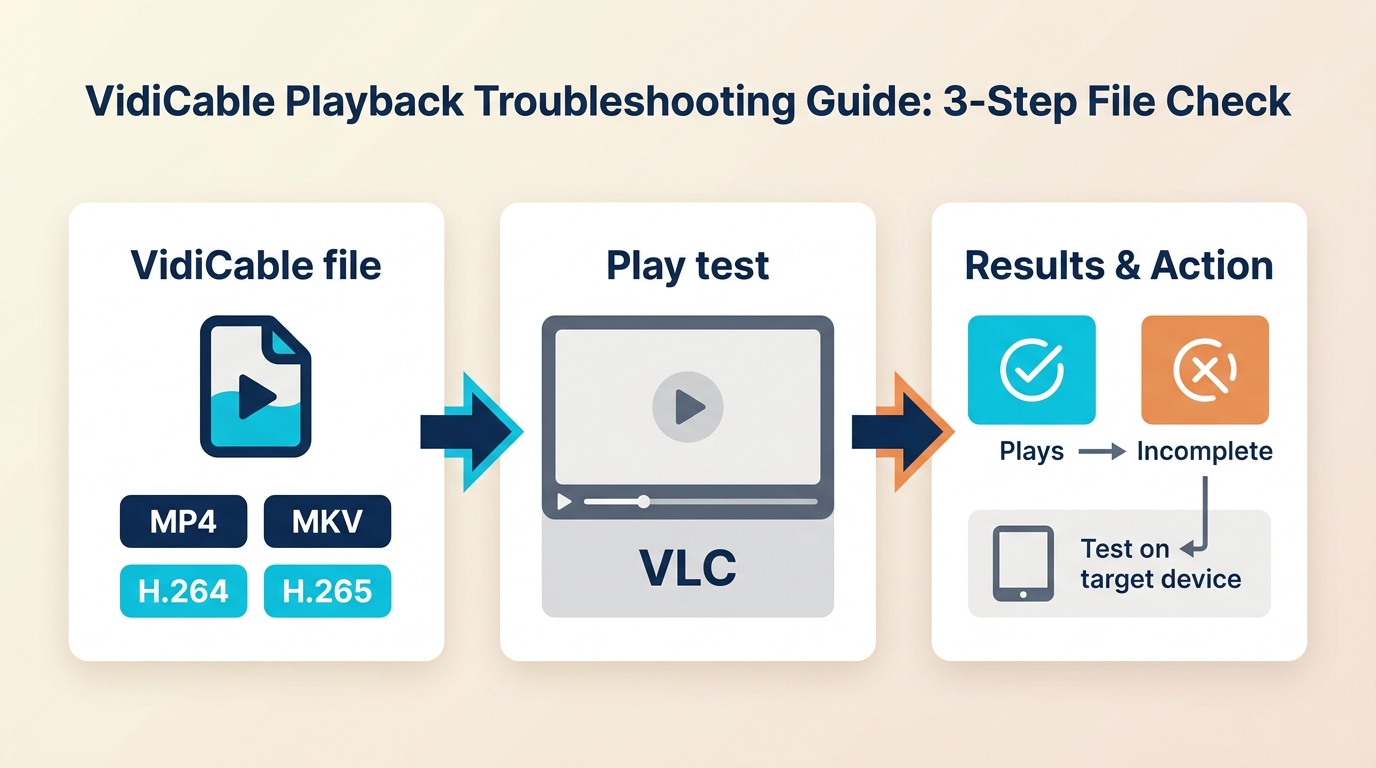
A completed download can still produce a VidiCable playback error because the file is incomplete, the player lacks the codec, or the destination device does not accept the chosen container. Diagnose playback before assuming the download stage failed.
Match the Symptom to the Fix
For a video stream decode failure or a file that opens on one device but not another, use this symptom-first sequence:
- Open the file in VLC or another player known to support the selected codec.
- Check that the task reached completion and that the file has a plausible duration and size.
- Retry the same title with H.264 instead of H.265.
- Compare MP4 with MKV while keeping the codec unchanged.
- Check the destination phone, TV, stick, or media server for codec support.
My editorial judgment is to test codec compatibility first when a file exists and has a normal duration. That separates a playback problem from a failed download with the least disruption.
Choose H.264, H.265, MP4, or MKV
For VidiCable MP4 MKV choices, the container and codec solve different problems. MP4 with H.264 is the broad compatibility fallback; MKV is useful when the destination supports it and you need its track flexibility. H.265 can reduce file size, but older playback devices may reject it.
If the file plays on the computer but not the destination device, keep the working source file and make the next test about destination compatibility rather than downloading the title repeatedly.
Understand Quality, Format, and Device Limits
VidiCable resolution limits depend on the source service, account tier, operating system, playback path, and the app's processing. A lower result is not automatically a software fault.
Service-Specific Resolution Limits
VidiCable supports MP4 and MKV output and advertises up to 8K for YouTube and up to 1080p on many services, but those figures do not apply uniformly. The service and account determine what source quality is available before output begins.
Compare the service, account tier, operating system, playback path, and selected output setting before treating the result as an error.
The useful distinction in streaming quality versus downloaded output is that software cannot create source detail the service never delivered. Transparent service ceilings are more informative than one headline resolution.
Windows, Mac, Mobile, and TV Compatibility
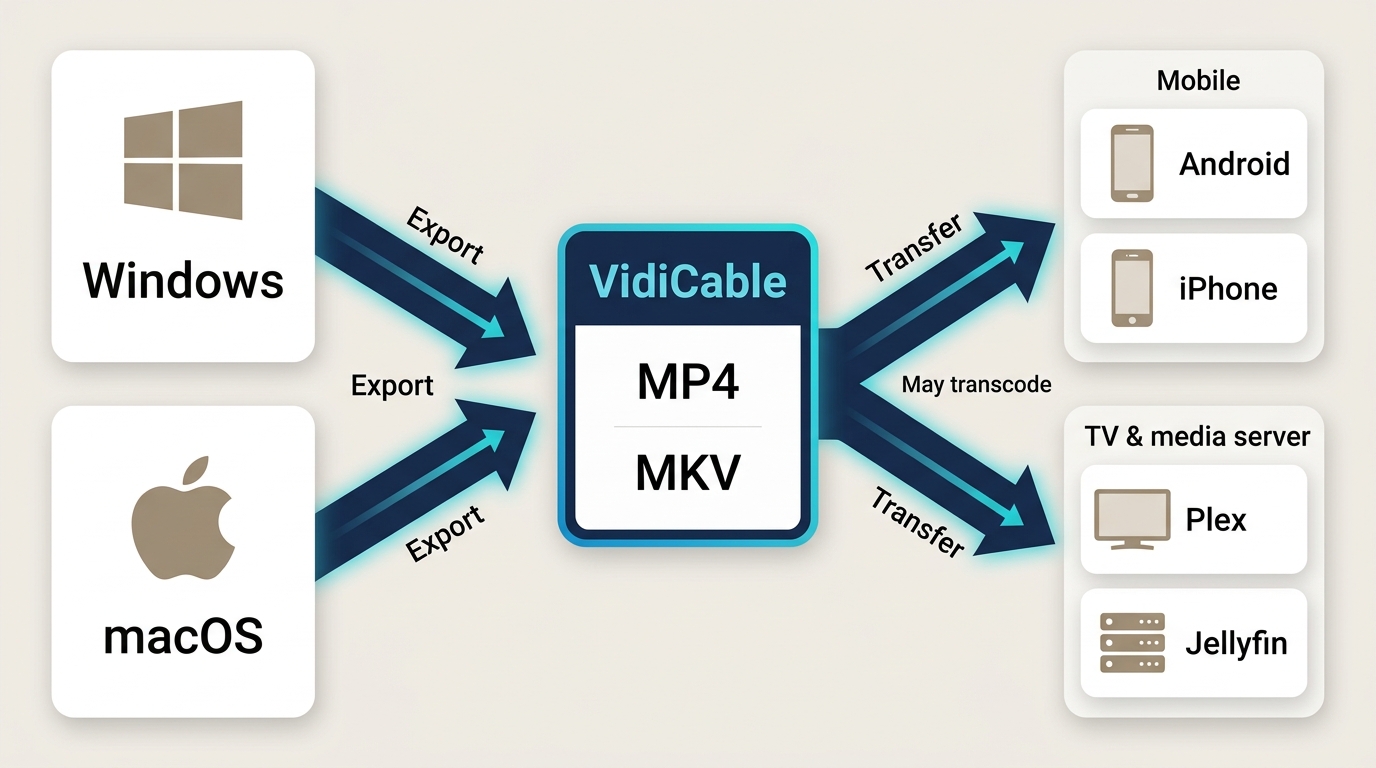
VidiCable Windows Mac support means the application itself runs on those desktop systems. Phones, TVs, streaming sticks, and media servers use a transferred or streamed local file, so their codec and container support decides whether playback works.
| Device | Runs VidiCable? | Local-file path | Compatibility point |
|---|---|---|---|
| Windows PC | Yes | Open saved file | Use H.264 fallback if needed |
| Mac | Yes | Open saved file | Check player codec support |
| Android or iPhone | No | Transfer MP4 or MKV | MP4/H.264 is broadly compatible |
| Smart TV | No | USB, casting, or media share | TV codec support varies |
| Streaming stick | No | Cast or media app | App and codec support vary |
| Plex or Jellyfin | No | Add file to library | Server may transcode |
Device availability and service support may change, so use the current VidiCable support page when a newly added platform behaves differently.
Local Files Versus App Downloads
VidiCable offline playback uses an ordinary local MP4 or MKV file, while an official streaming-app download remains managed inside that app. The official app may require an entitlement refresh; a local file instead depends on the player, codec, container, and the rules governing the authorized content.
What to Do When Fixes Fail
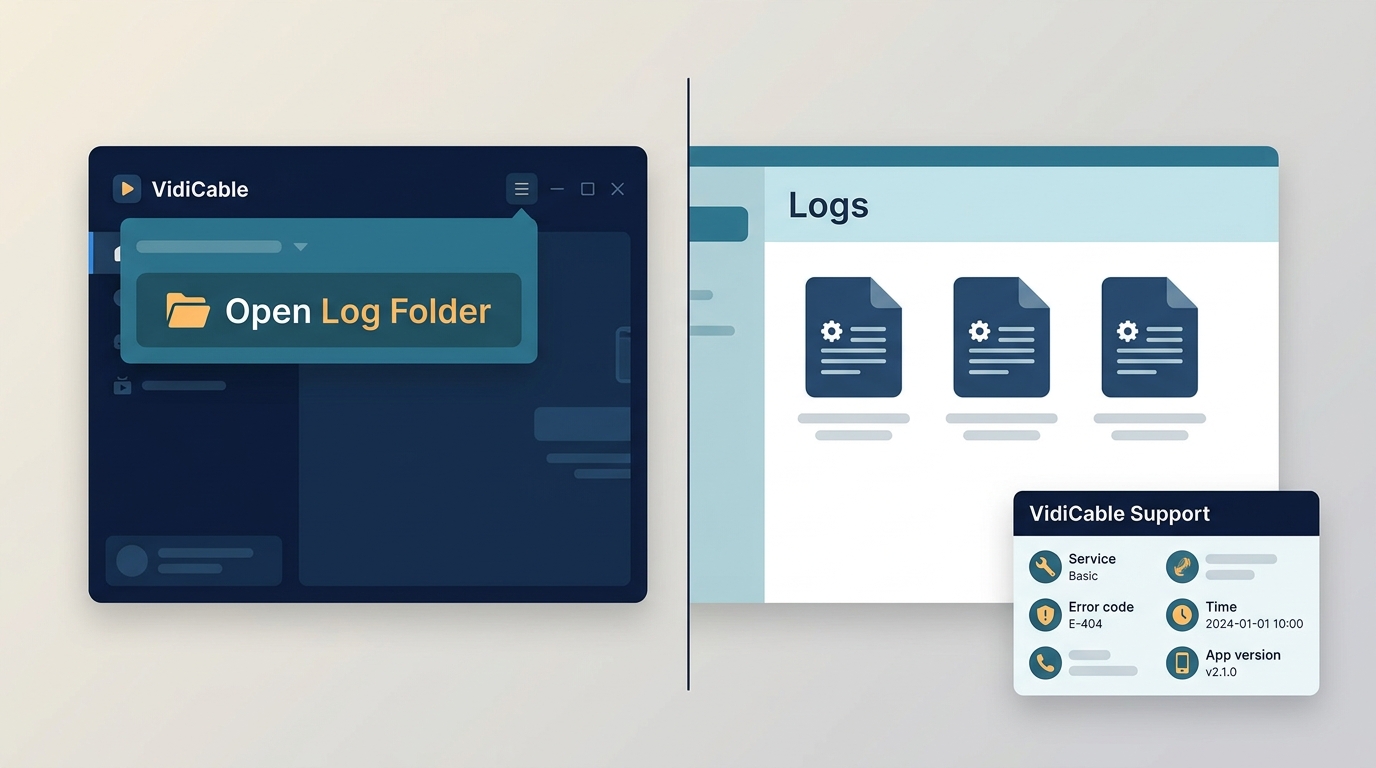
Stop repeating general resets once the current build fails on the same code, title, or output stage. A good escalation package makes the next step faster and preserves the evidence support needs.
Update, Collect Logs, and Contact Support
Install the current VidiCable build, reproduce the failure once, and then collect the latest logs. Include the service, title, season or episode, exact code, operating system, output folder, container, and codec.
- Open VidiCable's menu and choose the option to open the log folder.
- Identify the files created during the latest failed attempt.
- Note the exact title and where the task stopped.
- Send the logs and details to support@vidicable.com.
If one title still fails after the update, support escalation is more useful than another round of generic fixes.
A Desktop Fallback for Persistent Failures
For content you're authorized to access, where permitted by platform terms and applicable law, StreamFab All-In-One is a desktop fallback when VidiCable errors persist and a local-file workflow is still needed.
It fits Windows and Mac users who need MP4 or MKV output, H.264 or H.265 options, EAC3 or AC3 5.1 audio where supported, subtitles, metadata, batch work, and scheduled tasks. Ad handling depends on the supported service and current product path. Readers who want a mobile-only app should use a mobile-native workflow.
A broader VidiCable alternative comparison can help when the issue is product fit rather than one repairable code, but this troubleshooting path should come first.

My rule: use a fallback only after the current build, the code-specific fix, and a complete support report have failed to resolve the same repeatable problem. StreamFab All-In-One is a superior investment as its technology directly works around the browser-based resolution caps that limit VidiCable.
Safety, Licensing, and Offline Boundaries
Use official installers and keep offline-copy activity within clear access and usage boundaries. VidiCable's standard license is tied to one computer, and its limited trial is different from continued paid access.
- Authorized access: Use offline-copy software only for content you're authorized to access.
- Usage boundary: Follow platform terms and applicable law, and do not redistribute saved media.
- Installer safety: Download installers from the vendor's official site.
The same conditional boundary applies to StreamFab: follow the StreamFab copyright and usage guidelines, platform terms, and applicable law. Official app downloads and ordinary local files use different playback and entitlement models.
VidiCable Troubleshooting FAQ
Can VidiCable run directly on Android or a smart TV?
No. VidiCable runs on Windows and macOS. You can transfer or stream a compatible MP4 or MKV file to a phone or TV, but playback depends on that device's container and codec support.
Is VidiCable free after the trial ends?
No. The trial is limited, and continued use requires a paid license. The standard license applies to one computer, so activation limits matter when moving between systems.
Can VidiCable files work with Plex or Jellyfin?
Yes, if the server and playback device support the file's container and codec. MP4 with H.264 is the broad fallback; otherwise Plex or Jellyfin may transcode the file.
Do official streaming-app downloads need to reconnect to the internet?
They may need periodic entitlement checks because the download remains managed by the streaming app. That differs from VidiCable offline playback of a compatible local file in a regular media player.
Quick Troubleshooting Conclusion
The decision path is simple: run the five checks once, apply the code-specific fix, diagnose playback and codec compatibility, then update and send logs. Consider a desktop fallback only when the same repeatable failure persists.
VidiCable remains a suitable choice when its current build supports the reader's service, device, and quality needs. StreamFab All-In-One suits repeated failures or a broader local-media workflow, but it should not replace a straightforward VidiCable fix.

Evaluating the Audials One 2026 free trial? I tested its 720p caps, examined if is audials legal under Fair Use
By Erika Leen - Sep 29, 2026
Are you thinking of purchasing NoteBurner and unsure if it’s worth the investment? In this NoteBurner review, let’s delve into its product lines, particularly the NoteBurner Video Downloader’s pros and cons.
By Marcia Hatcher - Sep 28, 2026
Read our in-depth Audials review for 2026. Is Audials safe and legal for Amazon Prime? Discover actual test results, Widevine DRM fixes, and better alternatives.
By Erika Leen - Sep 28, 2026
TuneFab’s Amazon downloader suits a focused desktop routine, while VideOne covers multiple services. Compare their workflows, license structures, and output checks with StreamFab, then use the numbered setup and maintenance steps for authorized personal offline viewing.
By Erika Leen - Sep 24, 2026