
How to Convert iTunes M4V to MP4: Know Your File

Summary: This guide provides a roadmap for creating personal, local backups by converting iTunes M4V files into the universal MP4 standard. We explore two kinds of methods: traditional file conversion for existing M4V downloads and direct high-fidelity downloading for modern 4K content.
Use your file source and app setup to choose the appropriate path:
- Current Apple TV+ local-file workflow: For authorized Apple TV+ content when app-managed downloads do not meet your local-file needs.
- TuneFab M4V Converter status: Check the current product-page status and use free methods for eligible unprotected files.
- NoteBurner legacy context: Understand why older iTunes-library instructions do not map to current Apple TV app downloads.
Can iTunes M4V Still Be Converted?
To convert iTunes M4V to MP4, first determine whether the file is protected or unprotected. That distinction decides whether a standard iTunes movie converter can open it, whether free tools are appropriate, and whether the resulting MP4 will work on the device you want to use.
On Windows, Apple TV manages movies and TV shows, Apple Music manages music, and Apple Devices handles device syncing. iTunes remains mainly for podcasts, audiobooks, and PCs that cannot use the newer apps.

The filename alone is not enough to choose a workflow. An M4V file is a container, while protection status, codecs, and the software that created the file determine what an iTunes video to MP4 workflow can do.
| Method | Source eligibility | Setup and result |
|---|---|---|
| Rename extension | Unprotected M4V with MP4-compatible streams | Filename change only; test playback |
| HandBrake | Supported unprotected file | Desktop re-encoding to MP4 |
| VLC | Supported unprotected file | Local conversion; check playback |
| ViWizard iTunes M4V Converter | Compatible legacy iTunes library | Legacy app and operating system required |
| Official Apple download | Download-eligible Apple title | App-managed offline playback |
| StreamFab Apple TV Downloader | Authorized current Apple TV+ content | Windows or Mac; MP4 or MKV |
| ViWizard iTunes M4V Converter | Compatible legacy libraries | Windows requires iTunes 12.13 or earlier; not ideal for Apple TV app-only setups |
| Official Apple download | Titles available for official offline download | Managed in the Apple TV app, not a generic MP4 file |
| StreamFab Apple TV Downloader | Apple TV+ content you are authorized to access | Windows or Mac local-file workflow with MP4 or MKV, subject to service terms and applicable law |
Convert iTunes Movies to MP4
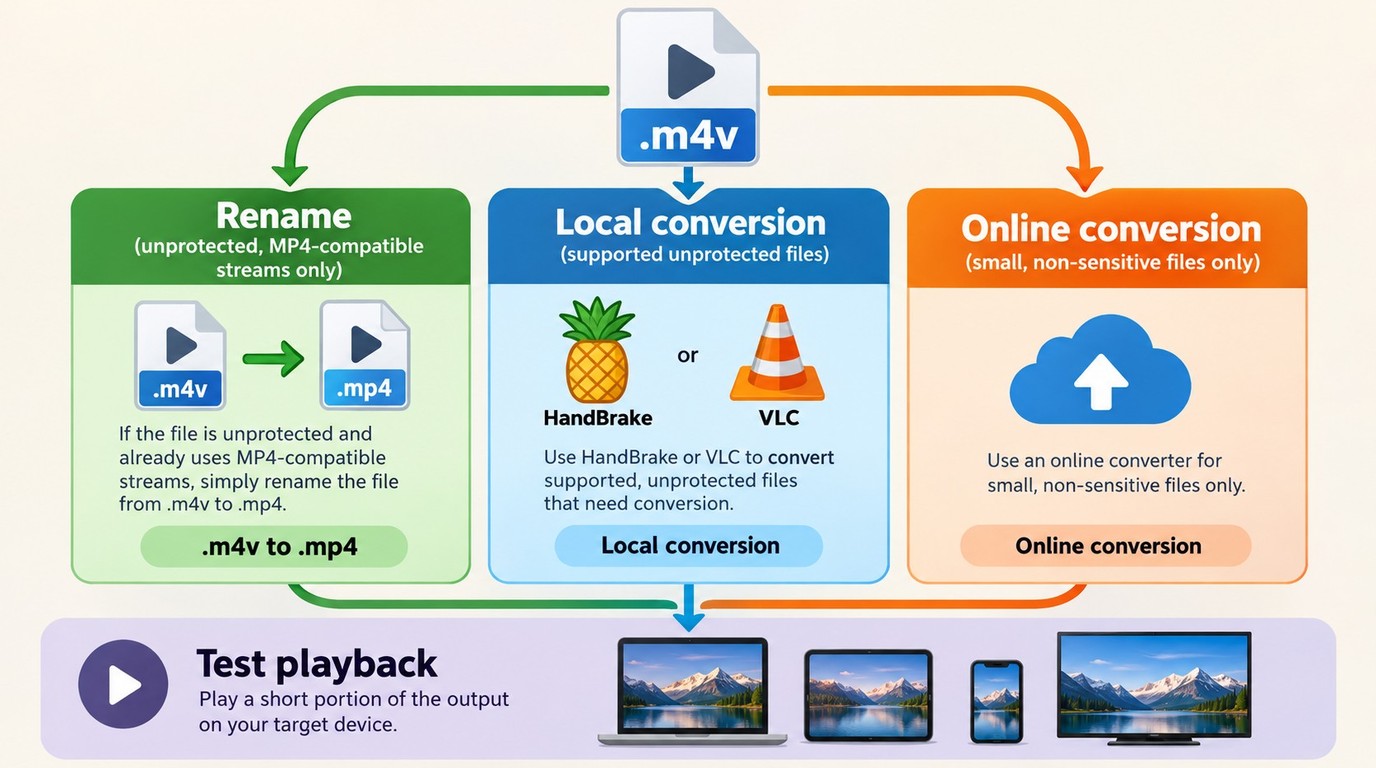
To convert iTunes movies to MP4, start with the source file rather than the tool name. Free desktop software can help with compatible unprotected M4V files; the legacy converter sections below apply only when a specific iTunes version or library setup matches.
Before converting, make a short test file and play it on the intended device. Container support, video and audio codecs, subtitles, and chapters can affect the final result even when the output extension is MP4.
Free Methods for Unprotected M4V

These options apply to unprotected M4V files on Mac and Windows.
- Rename a compatible file: Duplicate the original, make filename extensions visible, change
.m4vto.mp4, and check playback on the intended device. Renaming changes only the filename extension; the encoded video and audio data remain unchanged. - Convert with HandBrake: Open a supported unprotected source, choose MP4 and device-compatible video and audio settings, encode a short range, and inspect the result before converting the full file.
VLC is another local option for unprotected files it can open. Convert a short sample and check it on the target device before processing a larger library.
An online converter can be convenient for a small, non-sensitive file, but uploading a personal library adds a privacy consideration. For larger libraries, local desktop conversion is generally the more controlled choice because the file stays on your computer.
1. TuneFab M4V Converter Status
As of October 2026, the TuneFab M4V Converter product page is no longer available; the TuneFab brand website remains active.
For an eligible unprotected M4V file, use the free methods above. For content you are authorized to access on current Apple TV+, where permitted by platform terms and applicable law, use the current-platform section below for a local-file workflow.


2. NoteBurner Legacy Workflow Context
Older NoteBurner instructions were built around iTunes-library workflows rather than current Apple TV app downloads.
Current Windows Apple apps do not use the same legacy-library setup as those older instructions.


3. ViWizard iTunes M4V Converter
ViWizard lists iTunes 12.13 or lower for Windows and macOS 10.8–10.12 for its Mac version. This limits the converter to matching legacy-library setups rather than current Apple TV app workflows.

Step-by-Step Guide to Convert iTunes Movies to MP4 with ViWizard


Legacy iTunes libraries and current Apple TV+ viewing are different cases. If a legacy converter does not fit your app version or source file, a current-platform local-file workflow may be worth considering instead.
A Current Apple TV+ Local-File Option

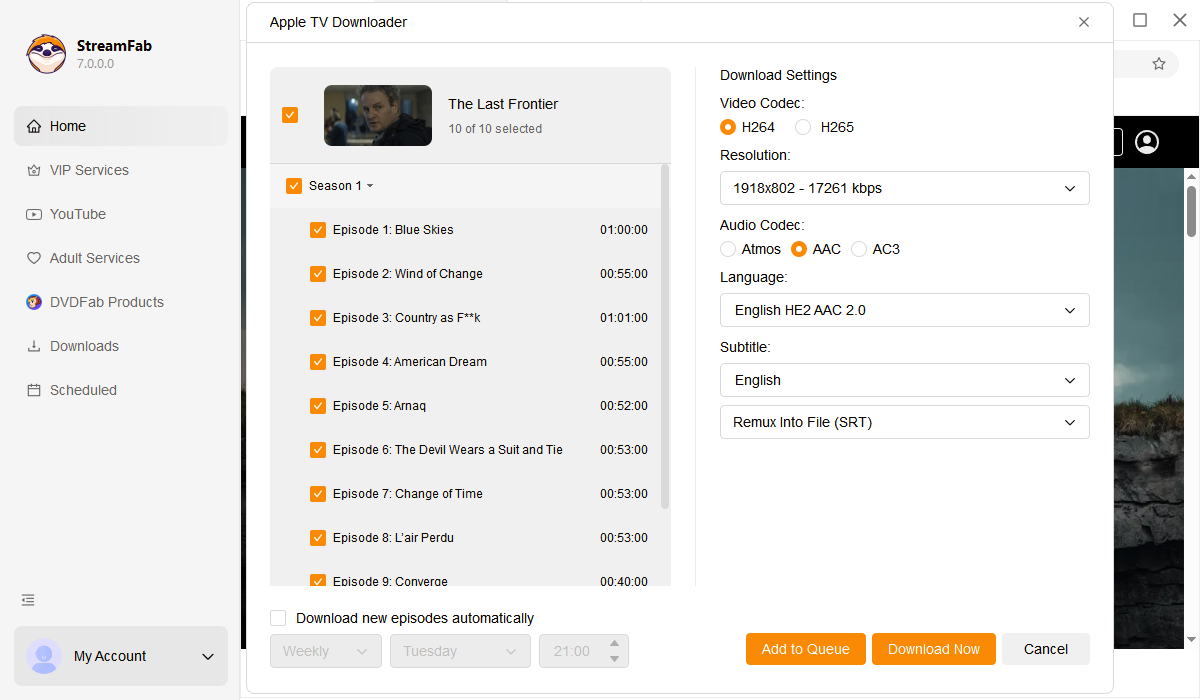
For current Apple TV+ content rather than an existing iTunes M4V file, StreamFab Apple TV Downloader provides a desktop workflow to save a local copy for personal offline viewing, for content you are authorized to access, where permitted by platform terms and applicable law. The Windows and Mac app supports MP4 or MKV output, 4K, 1080p, and 720p choices, H.264 or H.265 video, Dolby Atmos, AC3 5.1, or AAC 2.0 where offered by the source, selectable audio languages, subtitles, and batch tasks. You can Try for Free to confirm source, track, and device compatibility before adding a larger batch.

Choose this branch for an authorized current Apple TV+ local-file need rather than conversion of an older iTunes library. Official Apple TV app downloads remain the app-managed choice for standard offline viewing.
When Direct Saving Fits Better
This workflow is for current Apple TV+ titles, not for converting an existing iTunes M4V file. If an official Apple TV app download meets your offline-viewing needs, use the app-managed option; if you need an authorized local file for playback on a compatible device, the desktop workflow below is the relevant branch.
- Output choices: MP4 and MKV are available for local playback workflows.
- Video settings: available resolution depends on the source; supported choices include 4K, 1080p, and 720p.
- Audio and subtitles: choose available audio languages and download subtitles when those tracks are offered.
- Task handling: batch tasks and subscription-based follow-up are available for eligible titles.
- Playback check: test the selected file on the intended device because local codec support still varies.
Save Apple TV+ Videos in 3 Steps

Open Apple TV+ in the built-in browser, choose the available output settings that fit your device, and monitor the task before playing the finished file. Readers comparing Download Apple TV to MP4 can use the same source-eligibility check before choosing a workflow.


FAQs
1. Where does Windows manage Apple movie downloads now?
On Windows, the Apple TV app manages movies and TV shows, Apple Music manages music, and Apple Devices handles device syncing. A legacy iTunes workflow may require a specific app version, so do not assume that an older iTunes media-folder path or library database applies to the current Apple TV app.
2. Why won't HandBrake or VLC open my M4V file?
Work through a short checklist: confirm the file location, determine whether the file is protected, and make sure the program supports both the M4V container and the video and audio codecs inside it. Then check that the app version matches the requirements for your Apple or iTunes setup, convert a short sample, and verify playback before processing a full library.
3. Will conversion preserve video, audio, subtitles, and chapters?
Renaming changes only the filename extension, remuxing copies compatible streams into a new container, and re-encoding creates new video or audio streams that may affect quality or track handling. Check the output sample for video resolution, audio languages, subtitles, chapters, and metadata instead of assuming that an MP4 preserves every source feature.
4. Is converting a purchased iTunes movie legal in the US?
Access and convert only content you are authorized to use for the specific purpose, and follow the applicable license, platform terms, and US law. Do not share, distribute, resell, or use the files commercially.
5. Will any MP4 play on an older iPod or TV?
No. MP4 is a container, not a playback guarantee. The target device must support the file’s video codec and profile, resolution, frame rate, and audio codec. Older hardware may require more conservative settings, so test a short file on the device before converting an entire library.
6. Can I rename an unprotected M4V without losing quality?
Yes, if the unprotected M4V already contains MP4-compatible streams. Renaming the extension leaves the encoded video and audio unchanged, so keep the original and test playback; incompatible streams require conversion instead.
Conclusion
The practical order is simple: identify whether the M4V file is protected, use free conversion only for eligible unprotected files, and check the exact Apple or iTunes prerequisites before relying on a legacy converter.
For current Apple TV+ content, app-managed downloads suit ordinary offline viewing. Consider the desktop local-file branch only when you need an authorized local file and the workflow fits platform terms, applicable law, and device requirements.
- Start by identifying the M4V source and protection status before choosing a conversion method.
- For a compatible unprotected file, try a local free method and check playback on the intended device.
- ViWizard requires iTunes 12.13 or lower on Windows or macOS 10.8–10.12 on Mac.
- Current Apple TV+ content follows a different workflow from converting an existing iTunes M4V file.

To get straight to the point, US viewers can watch CODA without Apple TV hardware through Apple TV+, a current rent-or-buy listing, an official Apple TV app download, or an authorized desktop local-file workflow. The real choice is subscription access, one-title access, or offline control.
By Erika Leen - Nov 13, 2026
This article discusses how to record on Apple TV on a PC or Mobile device. It explains why common methods screen recording often fail, and introduces effective alternatives such as RecordFab and StreamFab Apple TV Plus Downloader.
By Jacob Harrison - Oct 28, 2026
Official Apple TV downloads stay inside the app; they are not portable MP4 exports. Identify your source, choose an appropriate desktop or local-video workflow, and verify the completed file. Learn what FRAG and MOVPKG files mean and how to check playback before transferring videos or queuing a season.
By Erika Leen - Sep 24, 2026
While the Apple TV app offers offline viewing, the files are temporary and restricted. This guide explores the best ways to create a permanent personal backup of your purchased or subscribed content, ensuring flexible playback across all your devices without expiration.
By Erika Leen - Sep 18, 2026