
The 2026 Guide to Save Amazon Prime Video on PC: 4 Tools Tested for Clean 1080p

Summary: I tested 4 tools to compare true WebRip decryption against screen recording. Discover how to bypass Widevine limits, fix hardware acceleration black screens, and permanently archive 1080p offline libraries in 2026.
Table of Contents
Prime Video PC Download Feasibility and Technical Limits
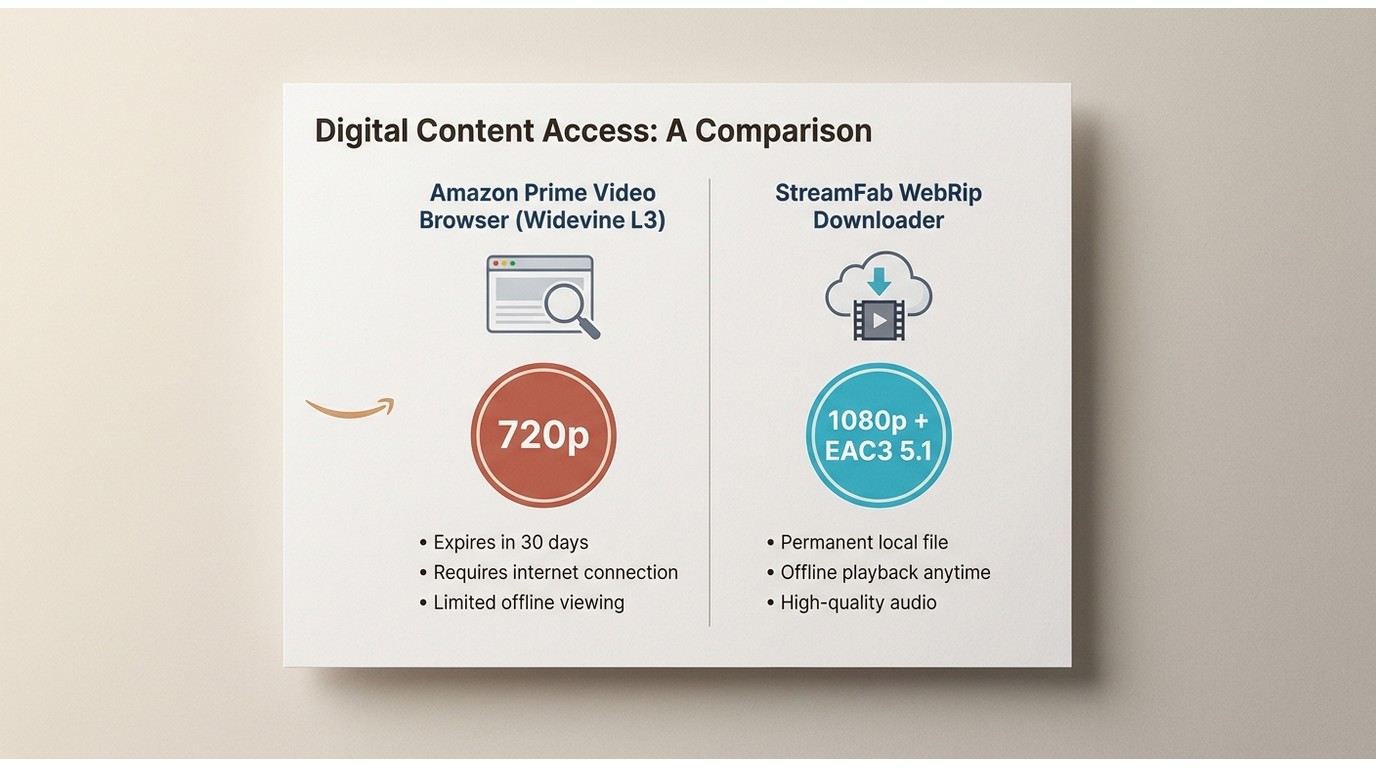
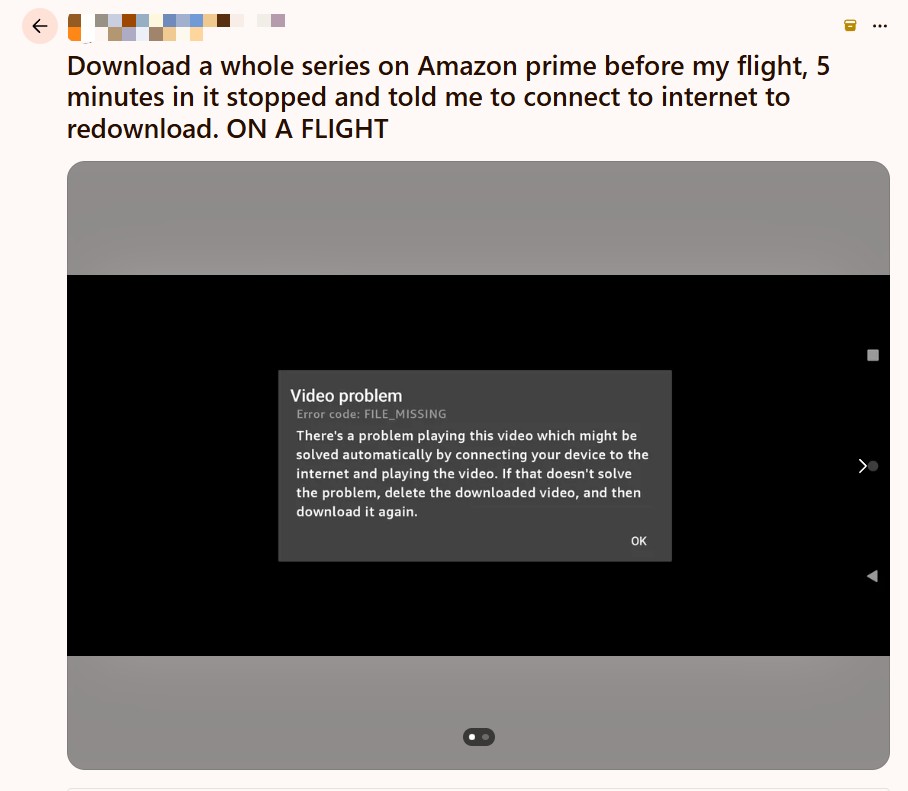
Last week, I needed to back up my purchased season of The Boys on my PC before a long international flight. Here's the short answer: Yes, you can save Prime Video titles you're authorized to watch onto a PC for personal offline viewing, but the official Prime Video app is the wrong tool for a high-quality local copy. Amazon caps stored downloads at roughly 25 titles per account; they expire about 30 days after download, and once you press play, you generally have 48 hours to finish. On PC browsers, the picture is usually held to 720p by Widevine L3 as an anti-piracy measure.
A desktop Prime Video download tool that uses screen-recording technology is the practical way to keep a cleaner 1080p personal backup of content you already pay for. If you want the full list of the official app's rules, see the sibling guide on Amazon Prime download limits.
Defining Personal Archiving and Compliance
Before diving into the tools, we need to establish the boundaries of digital archiving. In my view, ripping is about gaining control over the quality, subtitles, and audio tracks of content I have already paid for.
1. The Definition of Personal ''Rip'' Behavior & Legal Perspective
In my view, a personal "rip" is simply an act of enhancing my viewing experience of content I have already paid for by creating a private digital archive. It gives me more control over picture quality, subtitles, and audio tracks.
2. Safety Notice for Ripping Videos
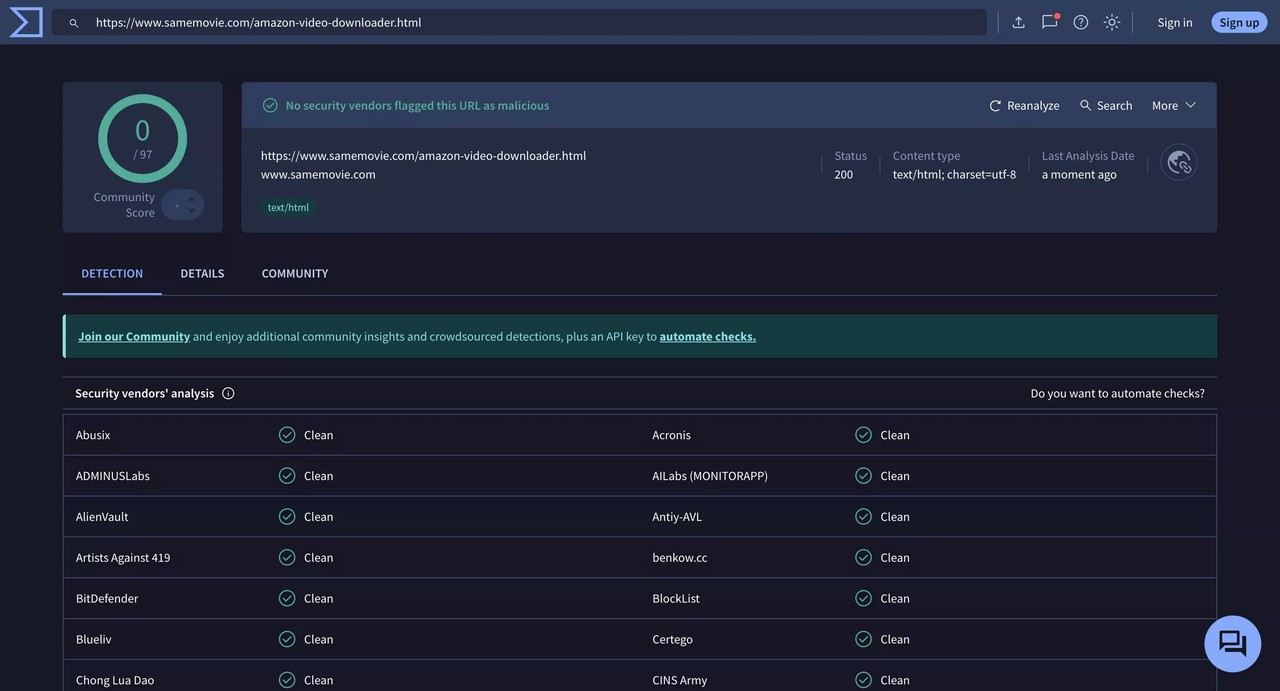
In addition to a legal perspective on personal ripping behavior, the safety of solutions chosen by you matters a lot, too. I scanned the installation packages of all four methods with VirusTotal, and none of them showed any malicious behavior. I also didn’t encounter unwanted plugins or pop-up ads during use, so I’m confident in their overall safety. Below is one sample scan result for reference:
To balance the demands of ripping movies and rules of downloading Amazon Prime videos, I suggest all users follow the 3 principles below to enjoy a stable Prime Video-watching experience:
- Prerequisites: You must have an active Amazon Prime Video subscription and valid account access to use these tools to save videos locally.
- Personal Use Only: Videos saved are for personal offline viewing only and may not be used for dissemination, commercial purposes, or copyright infringement.
- Compliance Recommendation: Please use these tools in compliance with local laws and Amazon's Terms of Use.
In other words, these solutions only help me save and archive the content that I have the right to watch so that I can watch it when I am traveling or offline. It is not a replacement for subscription services.
Top 2026 Amazon Prime Video Rippers Tested
When picking a reliable Amazon Prime Video ripper, the honest distinction is between desktop tools built around screen-recording / stream-recording technology and basic on-screen capture apps. The first category records what the Prime Video player itself is playing back in a controlled desktop environment, so the saved file keeps a clean 1080p picture and the original audio track for personal offline viewing. It does not decrypt DRM or bypass paid access — an active Amazon subscription is still required.
StreamFab Amazon Downloader: Desktop Screen-Recording for Prime Video
For content you're authorized to access, StreamFab Amazon Downloader is the desktop tool I keep coming back to. It uses screen-recording / stream-recording technology to save a local copy of what Prime Video plays — it does not decrypt DRM and does not remove Amazon's protection. In my workflow, that means I get a clean 1080p file with the original 5.1 audio track intact, instead of the 720p ceiling I normally see in a browser. It also exports to Amazon Prime Video in MP4 or MKV so the file plays in any standard player.
What it actually saves (per title, based on my tests):
- Video: up to 1080p, matching the Prime web player's ceiling
- Audio: selectable EAC3 5.1 or AAC 2.0 track
- Subtitles: exported as discrete SRT files or embedded into the video
- Container: MP4 or MKV, no proprietary player required
- Batch: whole seasons queued in one run, with scheduled overnight jobs

- Save Amazon Prime instant video for offline viewing and skip ads on supported titles
- Save Amazon video in 1080p resolution & EAC3 5.1/ AAC 2.0 audio quality
- Save video from Amazon Prime Video with 10X turbo fast speed.
- Explore batch processing of several videos with auto-saving of scheduled videos
- Free trial for new users to enjoy 3 Prime videos with full features.
I often queue up 4-5 episodes at a time, start them before bed, and have them all ready by the next morning. It also automatically detects new shows, like when a new season of The Boys is released.
Step 1: Download the Windows or Mac version. Open VIP Services on the left menu and select the Amazon icon. Log in with your active subscription account.
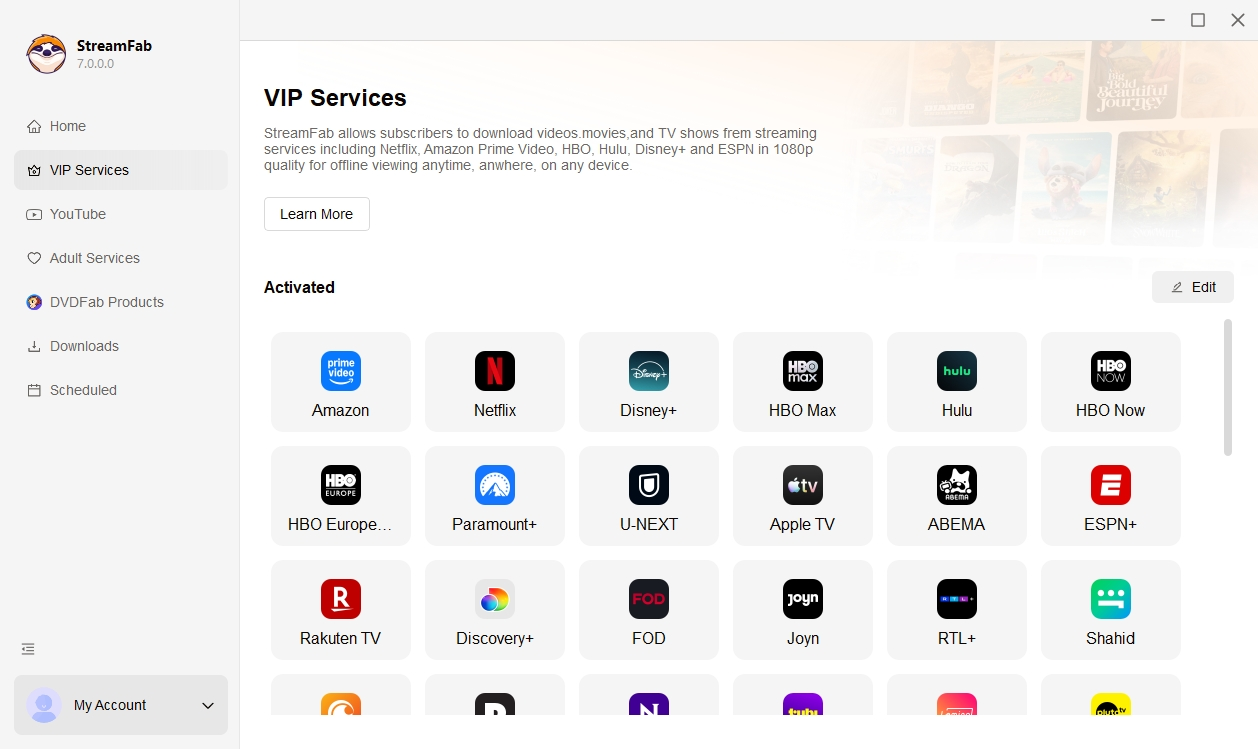
Step 2: Locate the title you want to archive. The built-in browser will automatically begin parsing the video stream without triggering playback.
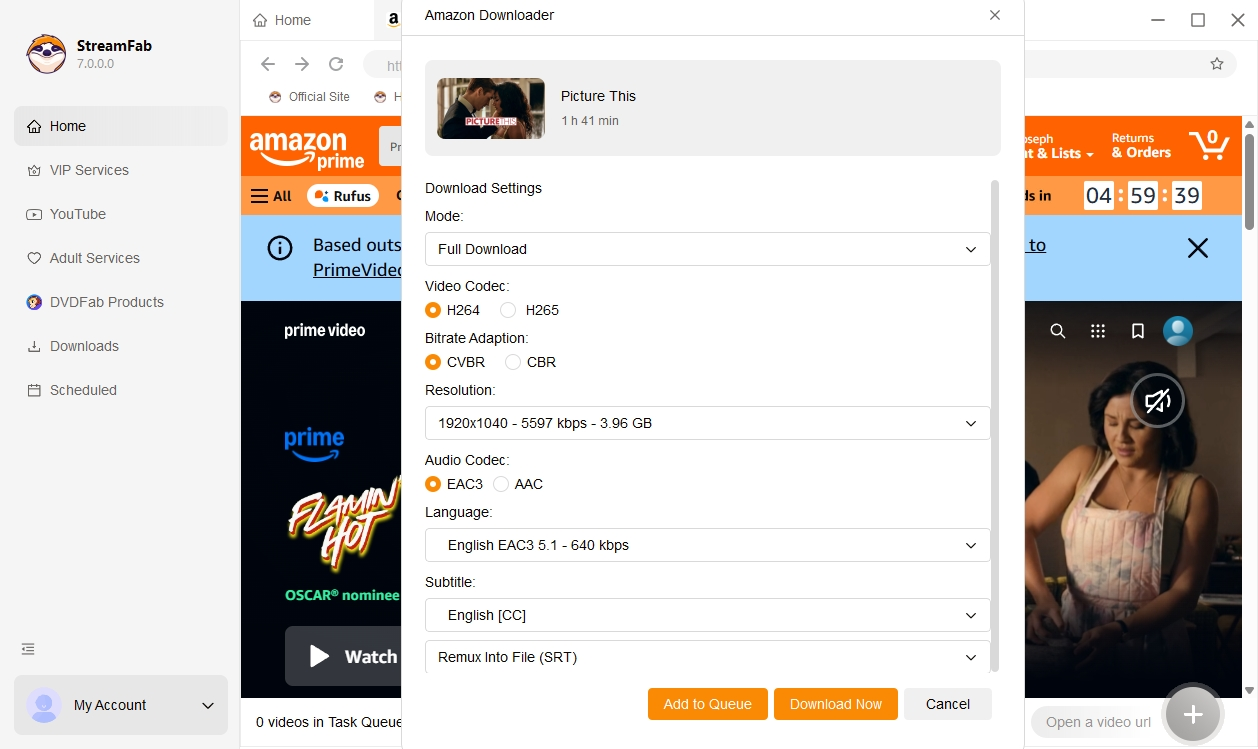
Step 3: In the resolution prompt, select 1080p, choose your preferred 5.1 audio track, and decide whether to embed subtitles or export them as discrete SRT files. Click Download.

Practical tip: Keep the app updated. Streaming players and their protection layers change often, and an outdated client is the most common reason a task stalls at 99% during analysis; running the latest version keeps compatibility and stability solid.
- Best for: archiving whole seasons of titles you're subscribed to in 1080p with 5.1 audio and clean subtitle files.
- Not ideal for: adding on-screen commentary or webcam overlays — for that, a dedicated recorder is the better fit. For background on how Amazon's protection layer works, see the sibling explainer on Amazon Prime Video DRM.
TuneFab: Lightweight Amazon Ripper Alternative
TuneFab is a lighter alternative. It skips the heavy batch workflow, but its built-in browser loads quickly, and it pulls TTML/SRT subtitles reliably, which is enough if you just want to watch Prime Video offline on a laptop. One thing worth knowing before you buy: its plans auto-renew, and per its own review notes, cancellation isn't a one-click toggle—you generally have to email support to stop the renewal. Factor that into the total cost. Best for: a single laptop, occasional one-off saves. Not ideal for queuing full seasons overnight.
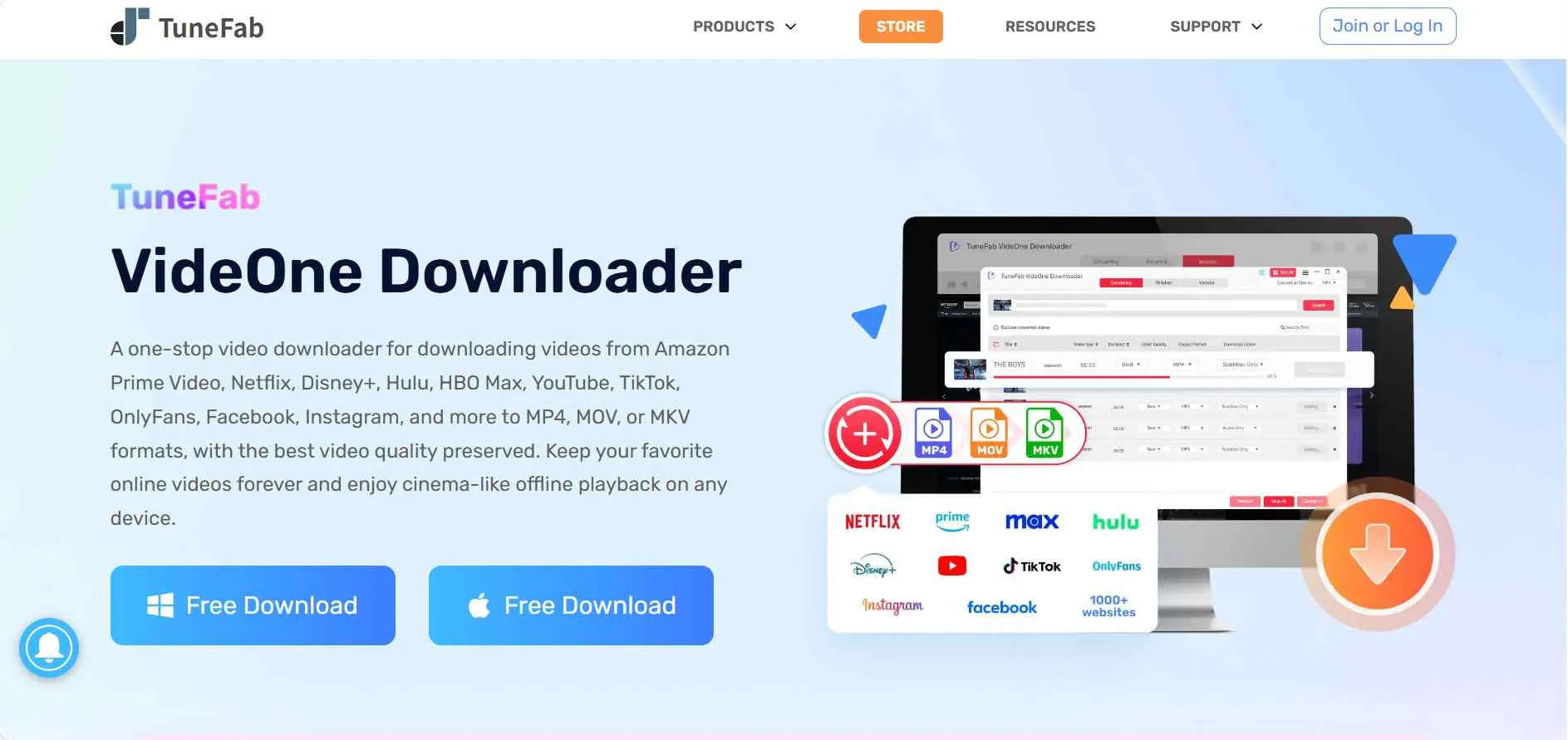
- Fast built-in browser: Pages and titles load quickly, making the parsing process smoother than many competitors.
- Subtitle exporting: Reliable SRT/TTML subtitle extraction with fewer parsing errors than similar tools.
- Simple workflow: Minimal setup—search, play, and download without complex configuration.
- Universal formats: Saves clean MP4 or MKV files that work on any device.
- Parsing instability: Some titles require refreshing or login repeats before detection works.
- Slower downloads: Movie downloads took notably longer than StreamFab in my tests.
- No advanced features: Lacks Extras download, auto-episodes, and higher-bitrate options.
Audials Movie 2026: Automated Screen Recording
If you prefer capturing the video output, Audials Movie acts as an automated recorder—you play the title in its browser, and it captures the screen in real time. Two things to plan for: the recording runs 1:1, so a two-hour movie ties up the machine for two hours; and if the system isn't configured properly, the file comes out as a black screen with only the audio surviving. As of July 2026, threads on Audials' own support community also report Amazon recordings failing outright, batch recording not working, and 1080p captures dropping to 720p on some protected titles. Best for: single short titles when a downloader isn't an option. Not ideal for: whole-season batches or unattended overnight jobs.
- Simple flow: Open the app, pick “Video Stream Recording," and sign in to Prime in the built-in browser. Hit play; capture kicks in immediately.
- Clean picture and steady sound: Files looked sharp, subtitles came through, and the audio didn’t wobble.
- Batch ripping: I queued two TV episodes, and it dutifully recorded them one after another.
- High failure rate: A few times the recording froze halfway—video stuck while audio marched on—leaving me with junk files.
- Long recording time: A two-hour capture for a two-minute clip—yep—same slog I hit with OBS and FonePaw.
- Windows-Only Supported: I use it on both Mac and Windows but discovered there's no Mac version.
EaseUS RecExperts: Multi-Source Capture
EaseUS RecExperts is extremely beginner-friendly. Its unique value lies in multi-source capture, allowing you to overlay webcam footage and mic audio over the stream—perfect for commentary or reaction videos.

Files stay small enough for an SD card, but you're still bound by real-time recording and the ever-present risk of a protected-title black screen depending on the browser setup. Best for: commentary or reaction workflows that need webcam + mic layered on top. Not ideal for: a hands-off archive of a full season.
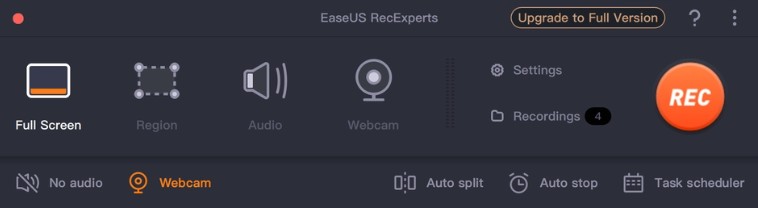
- Beginner-friendly UI: Simple layout that lets you start recording within seconds.
- Multi-source capture: Records system audio, microphone, and webcam overlay at the same time.
- Stable 1080p capture: Smooth motion and consistent frame pacing for regular episodes and clips.
- No fast capture: Must record in real time—20 minutes equals 20 minutes of waiting.
- DRM sensitivity: Occasional black screens depending on browser and hardware acceleration settings.
- Trial limitations: Free version restricts recording length significantly.
Stream-Recording vs Basic Screen Capture: Making the Call
If you're researching how to rip movies from Amazon Prime, the honest question is which recording technology holds up on protected titles. Here's how the four tools broke down for me on a 2-hour movie. One quick note on the free route: as of July 2026, using OBS to record Prime Video on Windows commonly ends in a black screen or heavy flicker, and Firefox tweaks are an unreliable community workaround—a purpose-built desktop recorder avoids that failure mode.
| Tool | Acquisition Tech | Typical PC output ceiling | Ads handling | Time efficiency | Pricing / Free trial |
|---|---|---|---|---|---|
| StreamFab | Desktop stream-recording | 1080p, 5.1 audio | Ads on ad-supported titles handled per platform behavior | Faster than real-time on typical broadband | Free trial covers 3 titles with full features; paid license after |
| TuneFab | Desktop stream-recording (lightweight) | 1080p, stereo | Manual skip typically required | Roughly 30–40 mins per 2-hour title | Free trial with strict limits; paid plans auto-renew, cancellation via support |
| Audials 2026 | Automated screen recording | Often 720p on protected titles (per community reports) | Records ads if they play | Real-time (~120 mins for a 2h movie) | Paid; trial with watermarked / length-limited output |
| EaseUS RecExperts | Desktop screen capture | Varies by display setup; black-screen risk on protected titles | Records ads if they play | Real-time (~120 mins for a 2h movie) | Free tier with recording-length limit; paid plan for full length |
The pattern is straightforward: the recording-based tools that stay closest to the Prime web player keep the cleanest 1080p picture and the original audio, while pure on-screen capture is where black screens, 720p downgrades, and 1:1 runtimes start to hurt.
Which Method is Right for You?
After testing all four tools, it’s clear that each one fits a different type of user. The biggest decision is whether you want real downloads or screen recordings.
If you just need a quick clip, or you're happy to let the computer run for the full length of a movie, a basic screen recorder like Audials or EaseUS RecExperts can get the job done. They capture what's already playing, so as long as the video plays smoothly, the recording does too.
But if your goal is to save full seasons, keep the original audio and subtitle tracks, or simply avoid black-screen failures, a dedicated desktop stream recorder is far more practical. StreamFab was the most consistent in my tests — no runtime restrictions, extras support, and stable saves at 1080p with 5.1 audio. TuneFab works too, but it's more basic and occasionally needs multiple attempts to load a title. Looking for a broader listicle beyond these four? See the best Amazon video downloader review.
So the simplest way to choose:
- If you value speed, stability, and high quality, use a downloader.
- If you only need short clips or commentary, a recorder works fine.
FAQs
Can I rip Amazon Prime Video directly inside the Prime Video app?
Not really for a high-quality copy. Amazon's official app lets you store roughly 25 downloaded titles at a time; they expire about 30 days after download, and once you press play, you generally have 48 hours to finish—many PC browsers also cap the picture at 720p. A desktop screen-recording tool is the practical way to keep a cleaner 1080p personal copy of titles you're authorized to watch.
Can I rip Amazon Prime Video in 4K?
Honestly, not for most workflows. Only a limited slice of Amazon's catalog is offered in 4K/UHD in the first place, and PC-based recording and downloading routes generally top out at 1080p because that's what the web player itself serves. If UHD is the goal, see the dedicated guide on downloading 4K movies on Amazon Prime for what's realistically possible.
Why do I get a black screen when I try to record Amazon Prime Video?
Protected titles block the render path that most generic recorders read from. OBS in particular commonly produces a black screen on Prime as of July 2026, and browser-level workarounds (Firefox tweaks, disabling hardware acceleration) are unreliable. A desktop stream-recorder built for Prime avoids the render-path issue and gives you a clean file at 1080p with the original audio.
Can I save just the audio from Amazon Prime Video as an MP3?
Indirectly. A desktop recorder saves the full video with a selectable audio track (EAC3 5.1 or AAC 2.0), and you can extract MP3 from that file afterward with any standard converter. A real-time recorder can't split the audio out separately — it only captures whatever plays through the speakers.
Is ripping Amazon Prime Video for personal offline viewing legal in the US?
Copying content you're authorized to access for private, non-commercial use is generally considered fair use under U.S. copyright law. Sharing, reselling, or public screening the saved file is not — and neither is canceling your subscription and trying to keep watching the platform's content. Keep it personal, keep the subscription active.
Conclusion
After running these methods through the 2026 streaming landscape, my takeaway is straightforward: basic screen recorders technically work, but tying every save to real-time playback and fighting hardware-acceleration black screens makes them a poor fit for building a personal offline library.
A purpose-built desktop stream recorder is the more practical route. StreamFab Amazon Downloader was the most consistent in my tests — clean 1080p picture, 5.1 audio, and discrete SRT subtitles, without forcing me to sit through the playback in real time and without decrypting DRM. For content you're already paying to watch, that's the setup I'd pick for a personal offline copy.


Yes, you can directly download Amazon Prime video on Mac through the official macOS app (subject to a strict 30-day limit) or utilize third-party downloders to export permanent local MP4 files. Explore my 2026 technical tests to avoid blackout restrictions.
By Erika Leen - Aug 26, 2026
Amazon Prime Video Channels like Starz, AMC+, and Acorn TV offer extra shows beyond standard Prime. But their downloads face time and device limits. This guide explains the key difference between Prime vs Channels and shows how to safely download Channel videos.
By Erika Leen - Aug 25, 2026

I revisits the most iconic PBS Kids shows of the 2000s, sharing heartfelt recommendations and formative memories of each series,
By Erika Leen - Aug 21, 2026
You can download eligible rented Amazon movies and purchased titles through the Prime Video app, but rentals have limited viewing Windows and app-managed storage. This guide explains the official route first, then a desktop local-file workflow for authorized viewing when format, audio, or playback flexibility matters.
By Nicole Lopez - Aug 11, 2026